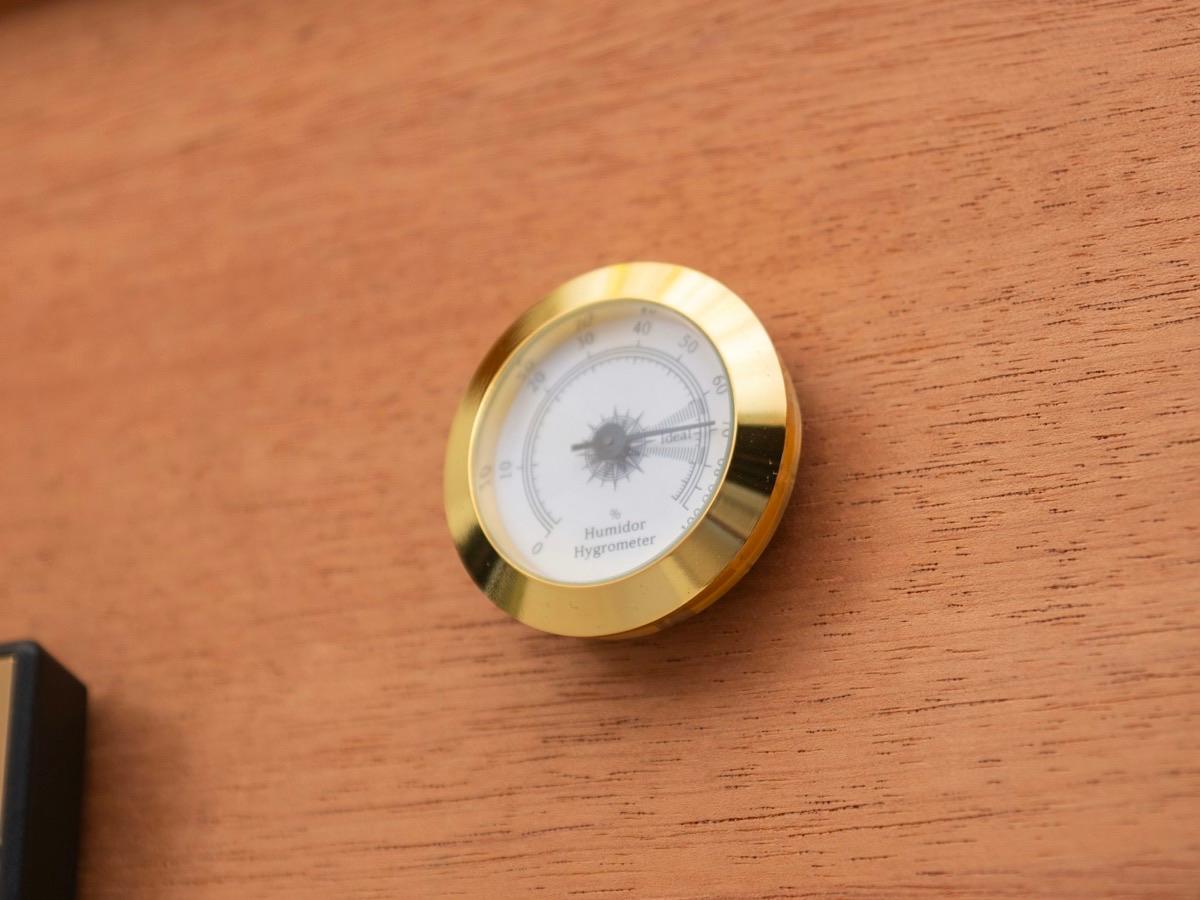
A humidor is not just a box. It is a small room whose wooden walls hold and release water, and it works well only when those walls are themselves in balance. A new humidor arrives with dry wood, and dry wood is a sponge. This lesson explains what seasoning does, why the lining is worth wetting deliberately, how to tell whether the humidor seals, and the two ways of wetting the wood — and how to know when the box is ready. Types of Humidors, in the Humidor Essentials topic, describes the different kinds of box, and Maintenance and Hygrometers describes the routine that follows.
Why a new humidor is thirsty
Tobacco is hygroscopic: it takes up water from the air around it and gives water back, always moving toward an even balance with that air. A cigar's wrapper, binder and filler are all dried and fermented leaves, and like the wood of the box they share this habit. A fresh humidor interrupts that balance. Its cedar arrived from the maker with little moisture in it, so the moment cigars are added the wood pulls water out of the air — and, when that is not enough, out of the cigars themselves, which sit closest to the walls. The cigars lose moisture, their wrappers tighten and crack, and the flavor goes flat. Seasoning saturates the wood first, so that there is no thirsty surface left to rob the cigars.
The aim is not to soak the wood. It is to give the wood the water it would take from the cigars anyway, in a controlled way, before the cigars pay for it.
Spanish cedar and its work
The lining of a traditional humidor is Spanish cedar, *Cedrela odorata*, a hardwood from the Caribbean and Central and South America rather than a true cedar (the true cedars are the genus *Cedrus*). Cuban makers call the wood *cedro*, and it is the same wood that lines Habanos dress boxes. It is chosen for three jobs. It holds and releases moisture in a slow, buffering way, which smooths the swings of humidity inside the box. It carries its own mild, cedary aroma, which sits well with tobacco and does not fight a cigar's wrapper. And it has a long-standing reputation for discouraging tobacco-beetle larvae, though the modern evidence for that third claim is thinner than the tradition suggests.
Not every humidor is lined with Spanish cedar. Some use Honduran mahogany or untreated interior woods, and cheaper boxes line only the floor or tray. The wood matters because the wood does the buffering: a humidor with no cedar, or almost none, relies almost entirely on its humidifier to hold the humidity steady.
The seal
Before wetting a box, it is worth checking that the lid closes tightly. Moisture leaves a leaky humidor far faster than its humidifier can replace it. The usual test needs nothing but a slip of paper, a bank note or a thin card: trap it under the closed lid and draw it out slowly. If it pulls with a steady, even drag, the lid and base meet closely; if it slips out with no resistance, the seal is poor. A well-fitting lid also drops the last fraction of a centimeter with a soft cushion of trapped air. A seal that fails the test can sometimes be improved by seasoning — wood swells slightly as it takes up water — but a badly warped lid may need to be exchanged.
How to season
Two schools exist, and both use distilled water. Distilled water is pure water with the minerals removed; tap water carries minerals and dissolved salts that stay behind in the wood and in a humidifier, where they encourage mold and clog the pores that should be breathing.
The gentler school wets the box slowly with no liquid touching the wood. A small, open dish of distilled water is set inside, the lid is closed, and the box is left for several days while the cedar takes the water out of the air. A seasoning pack made to hold about 84 percent relative humidity, of the kind Boveda sells, does the same job more slowly and precisely, and many makers now recommend it over the dish. Humidification Methods describes these and the other devices.
The wiping school moistens the wood directly. A clean cloth is dampened with distilled water — damp, not wet — and wiped over every interior surface, then a dish of water or a seasoning pack is added and the lid closed. The risk is overdoing it: a cloth that drips swells the grain, and a box that is genuinely soaked can warp or leave its wood permanently too wet. Wiping is optional; a dish or a seasoning pack alone is enough.
Whichever method is used, the lid stays closed during seasoning, and the whole job takes from a few days to about two weeks, depending on how dry the wood and the room were to begin with. A larger cabinet takes longer than a desktop box.
When it is ready
Readiness is measured, not guessed. A hygrometer, an instrument that measures relative humidity, is placed inside, and the box is checked daily. Humidor Essentials' Maintenance and Hygrometers explains calibrating the hygrometer first, because a gauge that reads a few points off changes the whole judgment. When the reading rises to the target — near the 65 to 70 percent the storage lessons recommend, or higher during seasoning, as the wood sheds its surplus — and holds there for a day or two with the water source in place, the wood has taken what it will. At that point the seasoning water comes out, the permanent humidifier goes in, and the first cigars can follow a day or so later, once the humidity has settled back to the long-term figure.