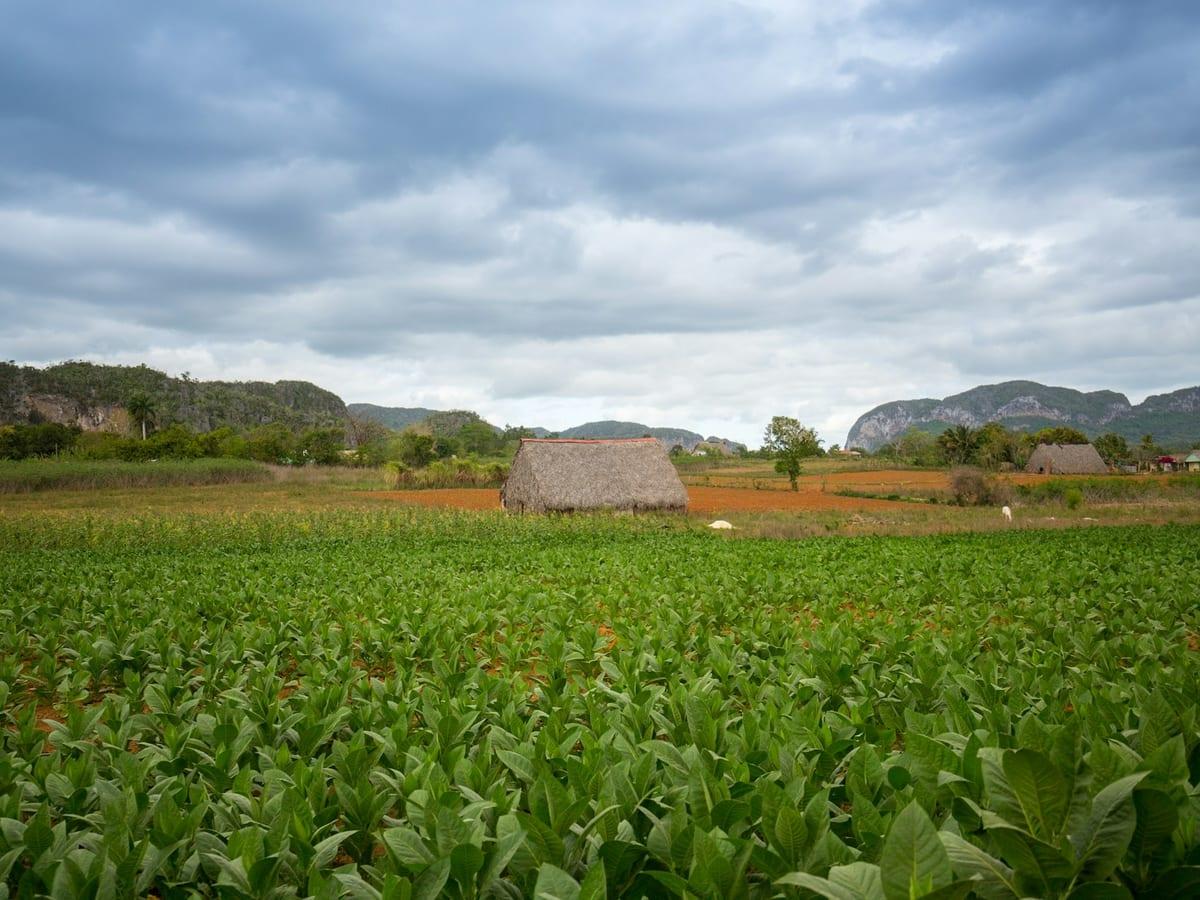
Most of the Cibao grows mild, aromatic leaf; La Canela grows heat. This lesson takes one small district of the valley and follows what its climate does to the leaf, why blenders reach for it, and who has made its name. It is a short lesson about a short distance: a few kilometers of drier ground turn the valley's mildness into something forceful.
A dry corner of a wet valley
La Canela lies within the Cibao's tobacco country, but on its hotter, drier edge. The Fillers topic sums up the difference: it calls La Canela a hot, dry corner of the valley where the climate gives stronger, spicier leaf, so that a Dominican cigar is no longer necessarily a mild one. Where the valley's rich center feeds cloudy, sweet-smelling Olor, La Canela's sun burns harder and with less rain, and the plant answers with a thicker, darker, more assertive leaf.
That is the general rule of cigar tobacco put in one place. The same variety, grown drier and hotter, changes; stress pushes the leaf toward strength. La Canela is where that rule shows up inside the Dominican Republic, which is why it has a name at all.
One farm, one cigar
The district's reputation rests on a single famous cigar. The La Flor Dominicana Double Ligero Lancero, made by Litto Gomez, the maker who put the word ligero on his bands and built his reputation on strong Dominican leaf, is rolled with all its inner tobacco from one farm in La Canela. In the Fillers topic it stands as the example of a single-farm cigar, one where the wrapper, binder and filler all come from one property, and that property is in La Canela. A whole cigar, not just a leaf, carries the district's character.
What the district teaches
La Canela is small, and its use in blends is narrow, but it is the clearest correction to the old claim that Dominican tobacco is mild. The valley is mild at its center and not at its edges, and a blender who wants a Dominican cigar with reach can find it in a dry district rather than by turning to another country. The lesson, like the district, is compact: terroir is local, and in the Cibao a little dryness and heat are enough to change everything.