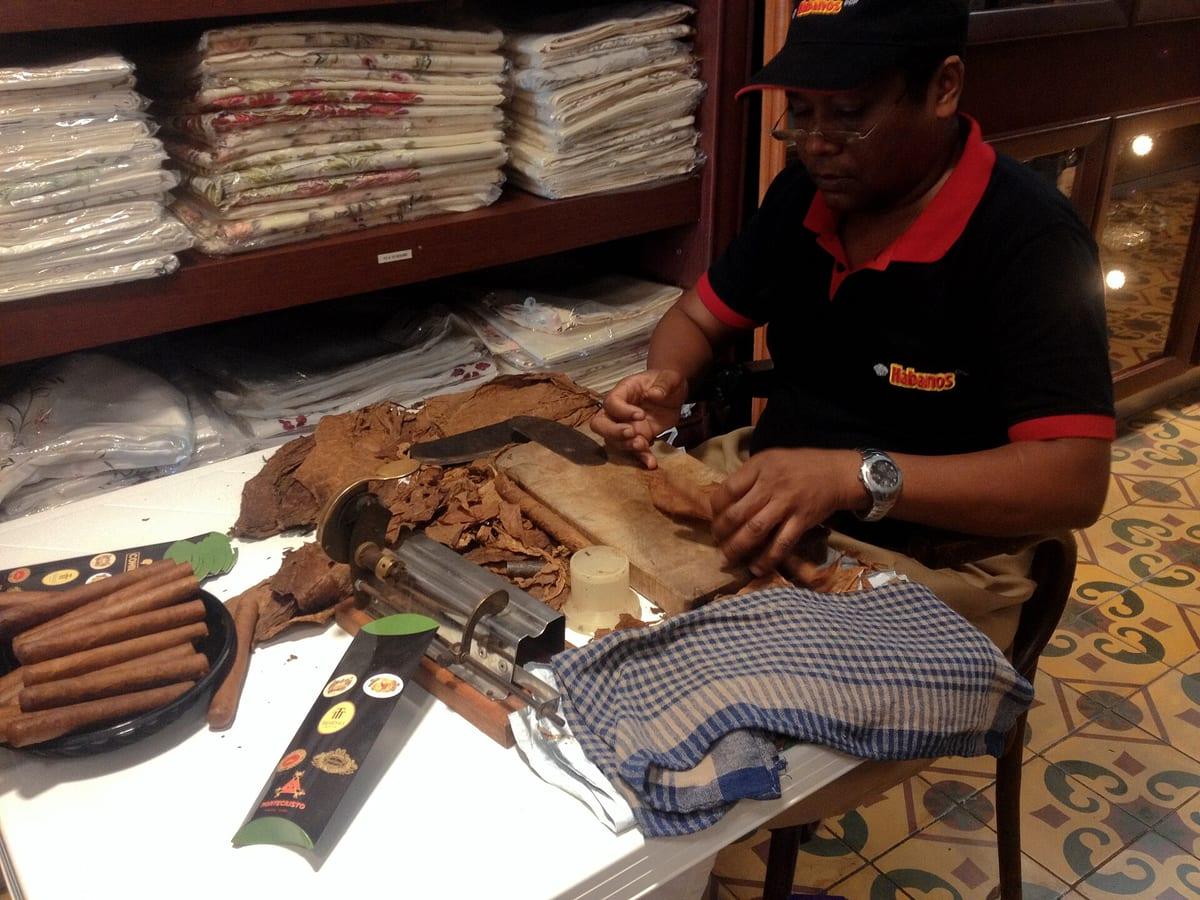
The leaf that reaches the sorting room has finished its fermentation and has most of its final character. What it does not yet have is a purpose. Sorters give it one. This lesson explains what the sorters do, the Spanish names for the work, and the sheer fineness of the judgment involved. It agrees with Cigar Construction, which describes the same grading from the cigar's side.
The escogida
In Cuba the sorting happens in a house of its own. The escogida is the sorting house where the classification of every leaf, wrapper, filler and binder alike, takes place, and it is also where the wrapper leaves are fermented. Wrapper is graded hardest of all. Habanos gives the grading of the wrapper its own name, the rezagado, the grading and final classification of the leaf by size, color and texture, and the wrapper leaves are sorted into some 50 categories. That fine division is why a box of Habanos can show so narrow a range of color, and Cigar Construction follows the wrapper from this grading to the rolling board.
The escogedores and the despalilladoras
Two trades share the sorting houses, and both are traditionally women's work. The escogedores are the color graders, and their name comes from escoger, "to choose". They work in pairs in the factory, sorting the finished cigars into 60 or more shades so that every cigar in a box matches, and arranging each box from dark to light, left to right; Habanos stresses that the color is entirely natural, with the upper leaves darker to begin with and darker still after fermentation. Alongside the sorters work the despalilladoras, the women who strip the midrib from the binder and filler leaves in the stripping house and from the wrapper leaves in the factory. Sorters and strippers are different jobs, but they sit side by side in the same rooms, and both were built into the trade's vocabulary in Cuba before spreading with it to the Dominican Republic, Nicaragua and Honduras. Sorting the colours, in the Cigar Terminology topic, is where the color matching is described in full.
What sorters look at
A sorter works through the leaf with a set of rules. The first is where the leaf grew on the plant, because volado, seco, ligero and the rare medio tiempo are folded and fermented differently and must not be mixed; in Nicaragua, the Dominican Republic and Honduras a fifth class, viso, sits between seco and ligero, as the Fillers topic explains. The second is the leaf's job: wrapper is chosen for color, smoothness, fine veins and the elasticity to stretch around a bunch without tearing, binder for strength and elasticity without regard to looks, and filler for taste and burn. The third is soundness. A wrapper leaf with a tear, a hole, a heavy vein or an uneven patch is still perfectly good leaf, but it will not be a wrapper; it is downgraded to binder or filler, which is why so much of a crop that fails the wrapper grades is not wasted.
The eye and the hand
Machines sort some cigarette tobacco, but premium cigar leaf is sorted almost entirely by hand. The reasons are the fine ones: a machine cannot reliably tell a micro-tear, a subtle difference in elasticity, the spread of oils across a leaf, or a slight step in shade. Many wrapper sorters work under strong, even lighting chosen to show flaws that ordinary light hides. The skill takes years to build, and in traditional factories a new sorter begins on the lower-grade filler leaf before being trusted with wrapper. Because sorting is the last place a leaf keeps its identity before blending and rolling, master blenders lean on the sorting room to keep a brand recognizable year after year, as the Master Blender lesson explains.