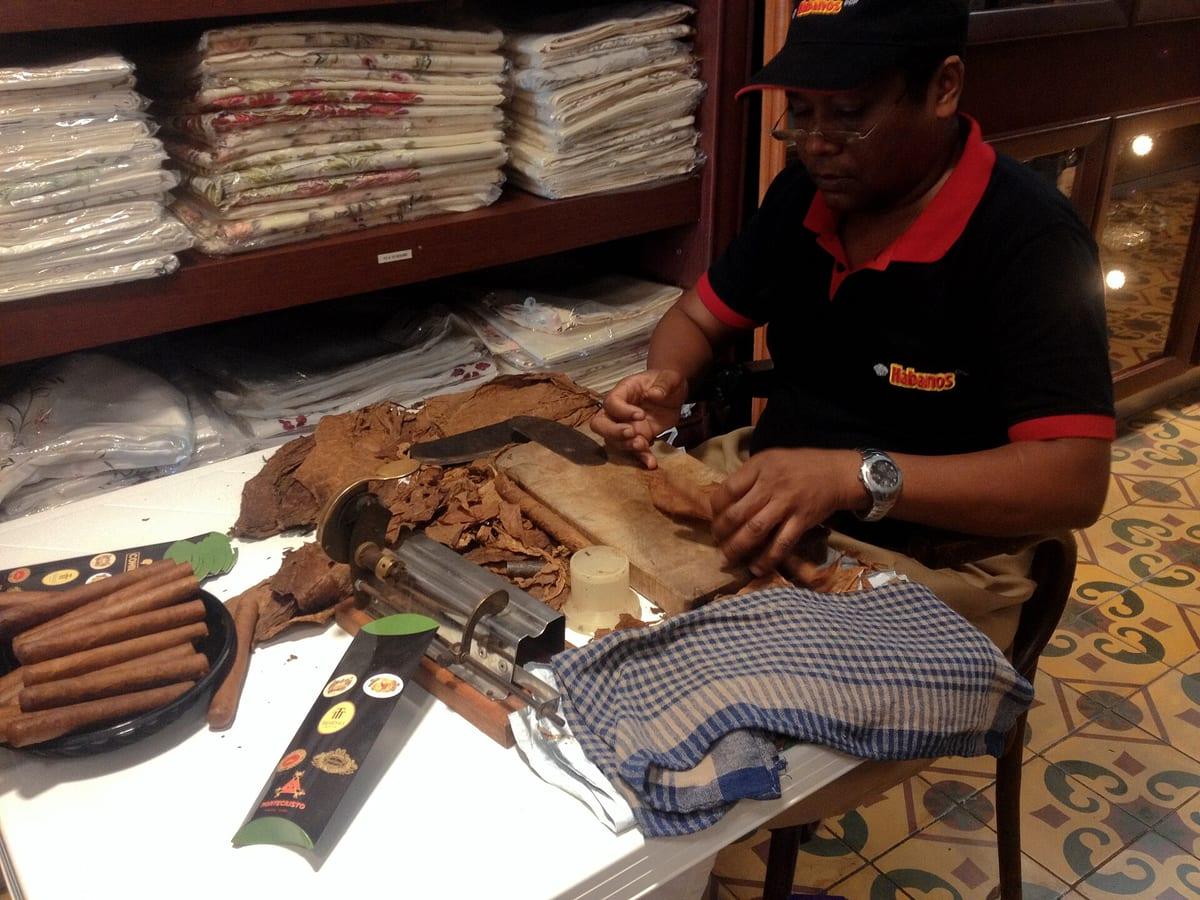
A cigar is a blend on paper until a set of hands turns it into a cylinder. The torcedor does that work, and every earlier step in this topic points toward it. This lesson follows the torcedor through the craft, the tools, the training and the way the job is divided between countries. It agrees with Cigar Construction, whose three lessons, Bunching the Filler, Binder and Wrapper Application and Pressing and Finishing, describe the same steps from the cigar's side.
What the torcedor is
The Spanish name for the roller is torcedor, from torcer, "to twist", and the finished cigar is a torcido, "the twisted". The name hides a warning: the Habanos glossary says of the torcedor that twisting "is the last thing a cigar roller should do when making a cigar". The leaves are folded into the bunch and rolled into the binder and wrapper under even tension, and a roller who wrings them pinches the air channels that decide the draw. The cigar is made on a tabla, a wooden board, with a small kit: the chaveta, a crescent-shaped blade for trimming the leaves; the casquillo, a little cylindrical punch that cuts the disc for the cap; a pot of goma, the tasteless, odorless vegetable gum, usually tragacanth, that holds the wrapper and cap; a guillotine to cut the cigar to length; and a cepo, a wooden gauge with a hole for the ring gauge and a notch for the length, to check the size.
One roller or two
How much of the cigar one person builds varies by country. In Cuba a single torcedor makes each cigar from start to finish, gathering the filler, rolling on the binder and stretching on the wrapper, with no split of the work. In Nicaragua, the Dominican Republic and Honduras the work is usually divided between two people: a buncher, the bonchero, makes the bunch, and once the bunches are pressed, a roller, the rolero, puts on the wrapper. In the Dominican Republic the buncher is often helped by a hand-cranked device, the Lieberman, also called a Temsco, that rolls filler and binder together on a canvas apron; it is used almost everywhere in the Dominican Republic, much less in Central America and not at all in Cuba, and the wrapper and cap are still added by hand. Whatever the method, the bunch is built by folding the filler leaves so they leave passage for air, ligero and the rare medio tiempo at the center with the lighter tips toward the foot, then pressed in a wooden mould, the molde, for half an hour or more to set its shape. Bunching the Filler, in the Cigar Construction topic, compares the folds.
The craft and the count
Habanos sets out the standard for the work in details that read like a contract. The compression of the filler must be the same at every point, and the bunch rolled to the exact diameter its size requires; the wrapper, a moist half leaf trimmed with the chaveta, is stretched on under even tension so that it lies smooth and the seams are tight, then closed at the head with a flag and cap. A roller who works a wrapper too tight will split it, and one who leaves it loose invites a runner, a seam that lets the burn race ahead. Habanos puts the output of a good torcedor at 60 to 150 cigars a day, depending on the size and complexity of the shape.
Training, rank and the lector
Becoming a torcedor is a long apprenticeship. In Cuba there are four grades of torcedor, and only the top grade is allowed to make the largest and most complicated Habanos; new rollers train before they roll for production, and most torcedores today are women. By tradition a lector, a reader, reads aloud to the torcedores as they work, from the daily newspaper and from novels chosen by popular vote, a Cuban custom that goes back to the 19th-century factories and survives today. Rollers are paid by the piece, and a cigar that fails a check is deducted from the roller's daily quota, which is why the craft and the speed are held in tension. Many factories outside Cuba cap how many cigars a team may make in a day to keep the work careful, and the Cigar Anatomy and Cigar Construction topics name the makers and the limits.