The wrapper, capa in Spanish, is the single leaf wound around the outside of a cigar. The filler at the core and the binder that holds it are hidden beneath it, so the wrapper alone gives the cigar its color, its sheen and its feel in the hand. It is also the first leaf to touch the lips, and it burns all along the outside of the cigar from the first puff to the last. No other leaf has as many names, as many ways of being grown or as much effect on a cigar's price. This lesson explains what the wrapper does, what a wrapper leaf has to be, how much it changes a cigar and how to read the words used to describe it. The other five lessons of the topic follow the leaf in more detail: Wrappers: Seed and Variety, Growing Methods, Origins, Color Scale and Popular Wrappers.
What the wrapper does
The wrapper's first job is to finish the cigar. Rolled in a spiral around the bunch under even tension, it holds the binder and filler in their final shape, and once the head is closed with a cap cut from the same kind of leaf, it keeps the cigar from unraveling. Its second job is to look right, because the wrapper is what a smoker sees in the box. Makers sort finished cigars by wrapper color so that every cigar in a box matches, and in Cuba the color graders, the escogedores, distinguish 60 or more shades.
Its third job is in the smoke. Because the wrapper burns all along the outside of the cigar, its oils and sugars color every puff, and because it touches the lips first, it shapes the first impression before the filler has said much. Yet it is only a small part of the tobacco, and the filler inside gives the cigar most of its strength and most of its body, as The Anatomy of a Cigar explains. What the wrapper adds is mainly flavor, aroma, sweetness and texture. A dark maduro wrapper makes a cigar taste richer and a little sweeter, but it does not make it stronger. Wrapper's Influence on Body, in the Strength vs. Body topic, shows how a wrapper's oils, sweetness and texture shape the body of a cigar.
Claims such as "the wrapper gives 60 or 70 percent of the flavor" are repeated often, but nobody has measured any such share, and how much a wrapper matters depends on the leaf and on the blend beneath it. A thin, pale wrapper over a strong Nicaraguan filler will usually show itself far less than a thick, sweet maduro wrapper over a gentle one.
What a wrapper leaf has to be
A wrapper leaf has to meet several demands at once. It must be thin enough to burn evenly with the leaves inside it and elastic enough to stretch around the bunch without tearing. It must be large enough to cover the cigar, because the roller cuts each leaf along its central vein into two halves and each half wraps one cigar, so a leaf usually wraps only two. Its veins must be fine and lie flat, its color even, and its surface free of holes, tears and stains. A leaf that falls short on any of these points can still go inside a cigar, but it cannot be a wrapper.
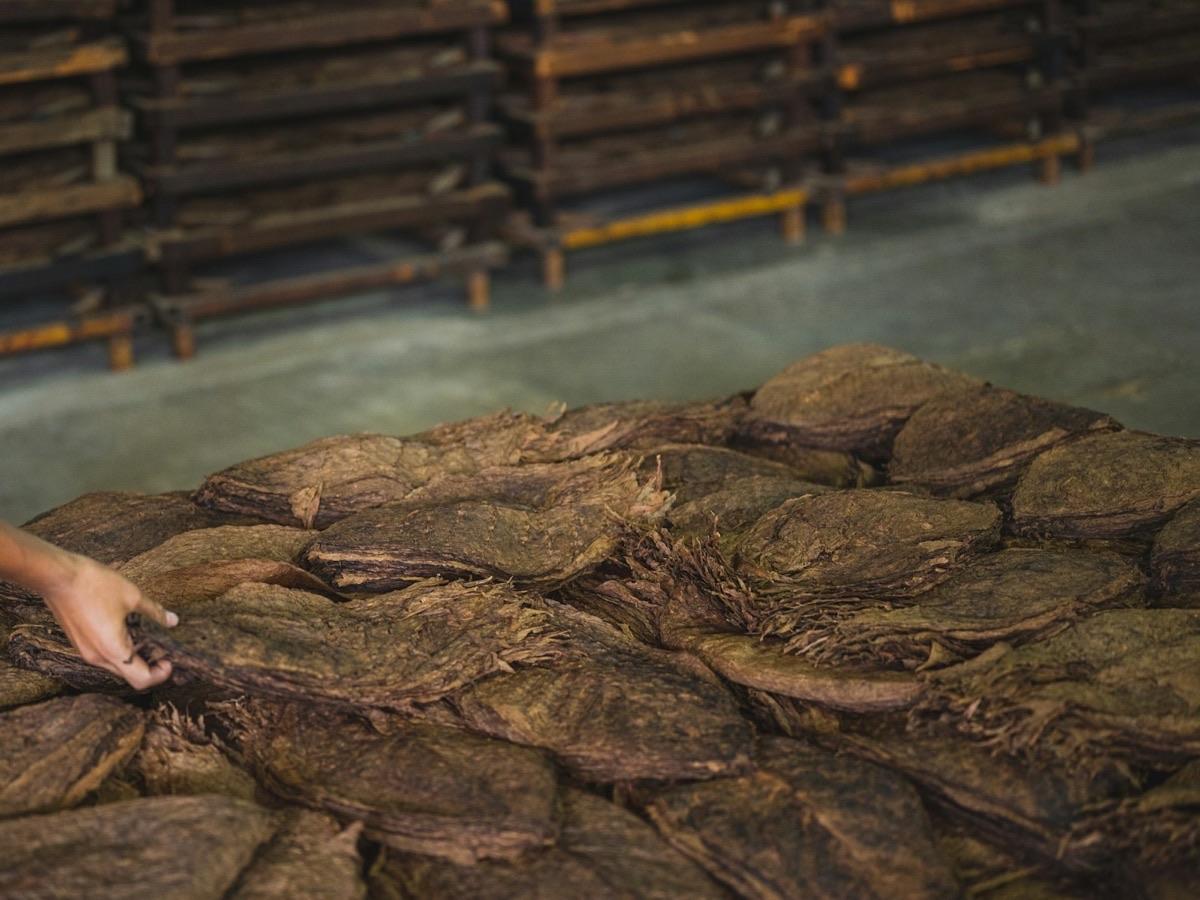
Growing such a leaf is slow and expensive, which makes wrapper the costliest tobacco in a premium cigar. Much of it grows under cloth, and in Cuba it takes some 5,000 yards of cloth, about 4,600 meters, to cover a single acre. Labor is the biggest cost of all, because wrapper is picked by hand a few leaves at a time, then cured, fermented and sorted leaf by leaf. In the late 1990s the best Connecticut wrapper sold for $45 to $50 a pound, while binder sold for about $8. Growing Methods follows the leaf from the field to the sorting table.
Only part of a wrapper crop becomes wrapper. Every leaf is graded by size, color and texture, and those that are torn, spotted or uneven in color go to binder or filler instead, the leaves the Binder and Fillers topics cover. How much passes varies widely: Ecuadorian growers have reported selling about four fifths of the leaf that reaches their barns as wrapper, while the Eiroa family's Corojo in Honduras gives 30 to 35 percent. The grading itself is fine-grained. In Cuba, wrapper leaves are sorted into some 50 categories, and in Connecticut the leaves from each priming, one picking from the same level of the plant, have been sorted into at least 18 grades.
How much the wrapper changes a cigar
The clearest way to see what a wrapper does is to compare one cigar in two wrappers, and many makers offer the same line in more than one. Padrón makes every size of its 1964 Anniversary Series in a sun-grown natural wrapper and a maduro, and the family has said that both come from the same plants. Most Perdomo lines come in three wrappers, an Ecuadorian Connecticut, a Nicaraguan sun-grown and a Nicaraguan maduro. Oliva's Serie V Melanio, added in 2012 and named cigar of the year in 2014, was set apart from the original Serie V above all by its wrapper, a Sumatra-seed leaf grown in Ecuador.
Smoked side by side, versions like these differ in sweetness, body and character far more than in strength. Reviewers link certain notes to certain wrappers, such as cream and cedar to Connecticut Shade, pepper and spice to Habano and Corojo, and cocoa and coffee to maduro. These are tendencies rather than rules, because the binder and filler shape a cigar's flavor as much as the wrapper does. Popular Wrappers describes what each common wrapper usually brings.
Reading a wrapper's name
The words used for a wrapper on a band, a box or a menu can describe four different things, and it helps to keep them apart. The table sorts them, with the lesson of this topic that covers each.
| What the word describes | Examples | Covered in |
|---|---|---|
| The seed, or variety | Connecticut, Habano, Corojo, Sumatra, Broadleaf | Wrappers: Seed and Variety |
| Where the leaf grew | Ecuador, Nicaragua, San Andrés, Cameroon, Brazil | Origins |
| How it was grown | Shade-grown, sun-grown | Growing Methods |
| Its color, or how it was fermented | Claro, colorado, rosado, maduro, oscuro | Color Scale |
Most names combine two or three of these. An Ecuador Habano Rosado is Cuban-seed leaf grown in Ecuador, with a reddish tint. A Connecticut Broadleaf Maduro is the thick, broad-leaved variety of the Connecticut River Valley, fermented dark. An Ecuador Connecticut is Connecticut-seed leaf grown in Ecuador, while Connecticut Shade on its own usually means leaf grown under cloth in the Connecticut River Valley itself, so the same word can name a seed in one wrapper and a place in another. Habano has two meanings as well. Outside Cuba it names Cuban-seed leaf grown anywhere, while in Cuba a Habano is a Cuban cigar, made only from Cuban leaf. Maduro names neither a seed nor a place but a dark color and the long fermentation that produces it, so a maduro can be Connecticut Broadleaf, Mexican, Brazilian or Nicaraguan leaf.
A country named on its own usually tells you where the cigar was rolled, not where its wrapper grew. Most Dominican cigars, for example, wear wrappers from other countries, as Origins explains.
Reading a wrapper before you light it
A good wrapper shows its quality to the eye and the fingers. Its color is even along the whole cigar, with a natural sheen from the leaf's oils. Its veins are fine and lie flat, its seams are tight and even with no lifting edges, and the leaf is supple, never cracked or papery. Some wrappers, most often Cameroon, have tooth: tiny bumps on the surface that are pockets of oil and that leave small white specks in the ash. Small white spots or green patches are marks left in the field or the curing barn, and they do not affect the smoke.
Two things can appear on a wrapper in storage, and they are easy to tell apart. Plume, or bloom, is a fine white powder that brushes off without leaving a mark, and it is harmless. Mold is fuzzy white, green or blue spots, usually at the foot or the cap, and it comes from storage that was too humid. A wrapper that has cracked or split along the leaf has dried out, or was brought back to humidity too fast.
The wrapper also shows itself in the burn. A supple, properly fermented wrapper burns evenly with the leaves beneath it. A runner, a narrow streak of burn racing ahead, usually follows a seam, a thick vein or a thin patch of the wrapper, and a wrapper that burns at a different pace from the binder can start a canoe, one side burning ahead of the other. Most burn faults, though, begin in the bunch or in storage rather than in the wrapper, as Construction Defects explains.