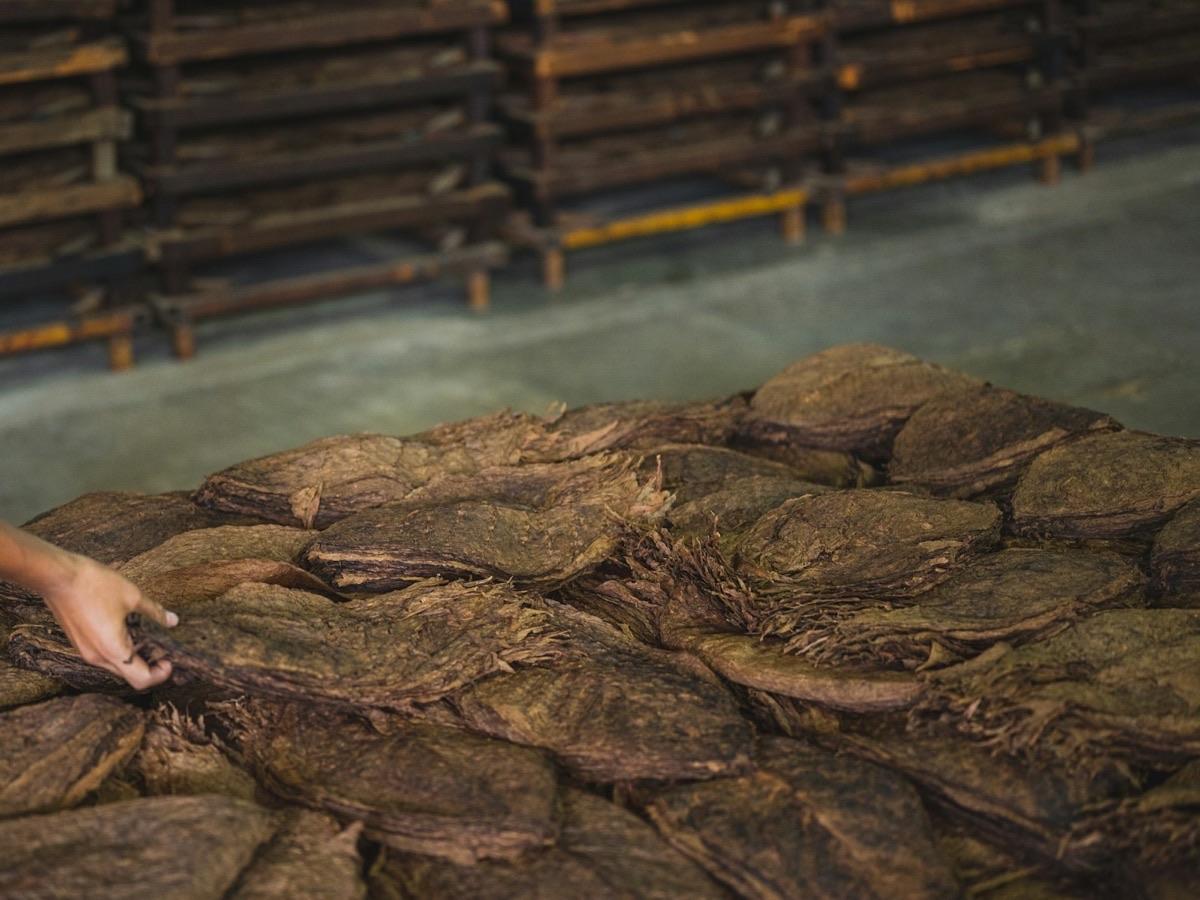
A tobacco variety is a strain of the plant with its own leaf size, shape, thickness, color and flavor, kept true by planting its own seed. Wrapper names very often name the variety rather than the place, so a Habano wrapper may have grown in Ecuador, Nicaragua or Honduras, and a Connecticut wrapper in Ecuador. This lesson traces the main wrapper varieties to their roots, explains how new ones are bred, and shows why the same seed can give a very different leaf in a different place.
Seed, variety and hybrid
Growers have always kept seed from their best plants, and over generations that selection fixed the character of each variety. Since the early 20th century, plant breeders have also made new varieties on purpose. A hybrid is a variety bred by crossing two others, usually to join one parent's resistance to disease or its yield to the other's leaf and flavor, and then selected for several generations until it breeds true. Once it does, its seed can be planted anywhere, which is why many of the best-known wrapper names now grow far from where they were bred.
One description on labels refers to seed alone. Cuban-seed, or Habano, means tobacco whose seed came from Cuba at some point, often decades ago, and has been grown and selected elsewhere since. It says nothing about where the leaf itself grew, and it should not be confused with Cuban leaf: Habanos, the Cuban cigars, are made only from tobacco grown in Cuba. Shade or Sun Grown, by contrast, describes how a plant was grown, not its seed, and Growing Methods covers it.
The Cuban family
Cuba's native tobacco is Criollo, the island's traditional dark tobacco, grown in full sun for filler and binder. Cuban wrapper came instead from a variety bred especially for it, Corojo. It was developed in the 1930s and 1940s by the Rodríguez family on El Corojo, a farm near San Luis in the Vuelta Abajo, and was named after the farm where it was tested. Cuba's tobacco scientists date its release to 1948 and describe it as a cross of Criollo with Sumatra-seed tobacco. From then until the mid-1990s, Corojo wrapped every Cuban cigar.
Corojo's weakness was disease. Blue mold, a fungus that attacks the leaves, destroyed more than 95 percent of Cuba's 1979–80 crop, and the island's Tobacco Research Institute, which supplies the seed every Cuban farmer plants, began breeding varieties that could resist it. Habana 2000, grown since 1992, was made by crossing Corojo with a mild Cuban cigarette tobacco, Bell 61-10, and crossing the result with Corojo again so that Corojo's character would dominate. It was designed to take Corojo's place as Cuba's wrapper, and by the mid-1990s it had. Criollo '98 and Corojo '99 followed, and later hybrids such as Corojo 2006 and Corojo 2012 have since been bred for Cuban wrapper.
Outside Cuba, these names travelled with the seed. Cuban-seed wrapper grown elsewhere is usually sold as Habano, or under the name of its variety. In Honduras, Julio Eiroa obtained Corojo seed, in the late 1980s by his son Christian's account (other family accounts say 1997), and grew it in the Jamastrán valley, and his family's Corojo became the wrapper of the Camacho Corojo. In Nicaragua, Aganorsa grows Corojo '99 wrapper under shade in Jalapa, and has lately added a newer variety, Corojo 2012, while Padrón wraps its cigars in Cuban-seed leaf grown in full sun. Ecuador grows Habano 2000 and Corojo '99 under its clouds. Even the Connecticut River Valley grows Corojo: Drew Estate's Liga Privada H99 wears an oily, reddish Corojo wrapper grown there. Corojo's yield of wrapper is low: the Eiroas' Corojo gives only 30 to 35 percent wrapper-grade leaf.
Connecticut seed
Connecticut Shade began with a foreign seed. In 1900 growers at Poquonock, near Windsor in Connecticut, raised the first crop of Sumatra-seed tobacco grown under cloth in the northern United States, with seed supplied by the U.S. Department of Agriculture, to compete with the Sumatra wrapper that American cigar makers were importing. The Connecticut Agricultural Experiment Station then bred the valley's own shade variety by crossing Havana-, broadleaf- and Sumatra-seed tobacco, and released it around 1910. Its smaller veins let rollers wrap more cigars from each leaf. Later strains followed, among them the 8212, first planted in the valley in 1982.
Connecticut seed gives a large, thin, smooth leaf that cures to a light golden brown and is known for notes of cream, cedar, hay and nuts. Much of it is now grown in Ecuador, where it is sold as Ecuador Connecticut: Davidoff, for one, moved its signature wrapper from Connecticut to Ecuador Connecticut in 2001.
Broadleaf
Broadleaf is a different plant altogether: a broad, thick-leaved variety grown in full sun and usually harvested by cutting the whole stalk. Connecticut Broadleaf has been grown in the Connecticut River Valley since the 19th century and for decades served mainly as binder. Today it is one of the main maduro wrappers, because its thick leaf stands up to the long, hot fermentation that turns it almost black, as on Drew Estate's Liga Privada No. 9. It now grows in Pennsylvania, Kentucky and Tennessee as well, and in Honduras, where Honduran broadleaf wraps the Rocky Patel Vintage 1990, aged 12 years before use, and the Alec Bradley Double Broadleaf.
Pennsylvania also has a leaf of its own, Pennsylvania Seedleaf, grown mostly in Lancaster County and also known as Pennsylvania Broadleaf. It has gone mostly into fillers and binders, and only lately into a few wrappers; some in the trade say it does not burn as well as Connecticut Broadleaf.
Sumatra and Cameroon
The island of Sumatra, in today's Indonesia, grew the most sought-after wrapper of the late 19th century. Dutch planters began growing tobacco in its Deli region in the 1860s, and by the First World War more than 92 percent of the wrapper the United States imported came from Sumatra. Its seed has travelled further than almost any other: it was the seed of the first Connecticut shade crop, one parent of Cuba's Corojo, and the ancestor of Cameroon wrapper. Today much Sumatra-seed wrapper is grown in Ecuador, where it gives a darker, oilier leaf than Connecticut seed, as on Oliva's Serie V Melanio.
Cameroon wrapper descends from Sumatra seed and grows in Cameroon and the neighboring Central African Republic, which is why some in the trade call it Central African leaf. It is thin and toothy, and Origins tells how it nearly disappeared in the 1990s.
The dark local leaves
A few wrappers come from old local varieties rather than from Cuban, Sumatran or North American seed. San Andrés Negro is the traditional dark leaf of the San Andrés valley in Mexico, a thick leaf fermented mostly for maduro. Mata Fina, from the Recôncavo of Bahia, is Brazil's best-known wrapper variety, a dark, naturally sweet, sun-grown leaf used as wrapper, binder and filler; Mata Norte is a subvariety grown in the north of the same region. Arapiraca, from the Brazilian state of Alagoas, is a heavier leaf, fermented mostly to maduro. Origins describes where each grows and the cigars that wear them.
The main varieties side by side
The table compares the main wrapper varieties by where they came from, where they grow as wrapper today and the leaf they usually give.
| Variety | Where it came from | Grown as wrapper today in | The leaf it usually gives |
|---|---|---|---|
| Corojo and its hybrids (Habana 2000, Corojo '99) | Bred in Cuba from Criollo and Sumatra-seed tobacco | Cuba; as Habano or Corojo in Ecuador, Nicaragua and Honduras | Medium to dark brown and oily, sometimes with a reddish tint |
| Connecticut | Bred in Connecticut from Sumatra-, Havana- and broadleaf-seed tobacco | The Connecticut River Valley, under cloth; Ecuador | Light golden, thin and smooth |
| Broadleaf | Grown in Connecticut since the 19th century | Connecticut, Pennsylvania, Kentucky, Honduras | Thick and sun-grown, usually fermented dark |
| Sumatra | The Deli region of Sumatra, Indonesia | Ecuador, Indonesia | Darker and oilier than Connecticut seed |
| Cameroon | Sumatra seed, grown in Central Africa | Cameroon, the Central African Republic | Thin, with tooth |
| San Andrés Negro | The San Andrés valley, Mexico | Mexico | Thick and dark, mostly for maduro |
| Mata Fina | The Recôncavo of Bahia, Brazil | Brazil | Dark and naturally sweet, sun-grown |
Read down the second column and a pattern shows: Sumatra seed lies behind three of the families, Connecticut, Corojo and Cameroon, which is why the old Deli leaf still shapes cigars that never touched Indonesia.
Why the name is only a starting point
The seed sets a leaf's possibilities, but where and how it grows decides what it becomes. Cuban-seed tobacco grown under shade gives a thinner, finer leaf than the same kind of seed grown in full sun, and Connecticut seed grown in Ecuador has a reputation for being more consistent, and cheaper, than the same seed grown in Connecticut. The position of the leaf on the plant matters too, because the upper leaves get more sun and grow darker and thicker. Then curing, fermentation and aging transform the leaf again: Padrón's natural and maduro wrappers come from the same plants. Two cigars with the same wrapper name can therefore taste quite different, and a seed name is best read as a family resemblance rather than a promise.